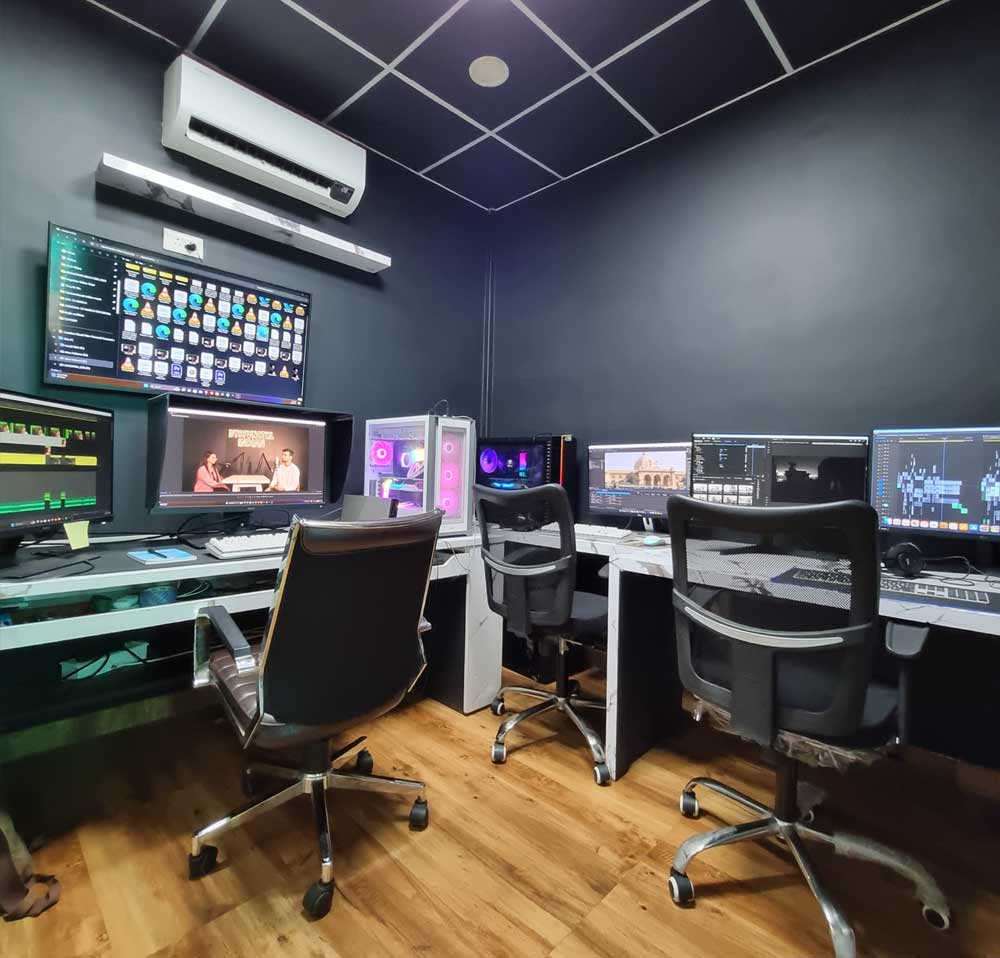
360° post-production is the process of designing every visual output of a project from one unified source material, not just finishing a film, but building an entire communication system around it.
Instead of asking “How do we deliver this video?” it asks “How will this story be used everywhere?”
The same footage should support:
Post-production becomes the stage where storytelling is engineered, not decorated.
1. Editing : Structure & Narrative
Editing determines clarity before creativity. It defines pacing, sequencing, and the exact moment the viewer understands the message. Good editing removes confusion so the audience never has to “figure out” the story.
2. Sound Design & SFX : Perception
Sound quietly shapes realism and attention. A well-designed soundscape:
Often viewers cannot explain why a video feels professional, sound design is the reason.
3. Motion Graphics : Explanation
Whenever communication includes process, statistics, or systems, footage alone struggles.
Motion graphics translate:
numbers → meaning
process → steps
results → visible change
This is where viewers stop watching and start understanding.
4. 3D & CGI : Demonstration
Some realities cannot be filmed:
3D visualisation shows what exists but cannot be seen. It removes the need for verbal explanation.
5. VFX : Believability
Visual effects integrate information into reality. Instead of telling viewers what changed, VFX lets them see
it within the same frame: overlays, comparisons, and hidden processes made visible. This is where
communication gains credibility.
6. Color Grading : Emotional Continuity
Colour is not beautification. It is consistency. Grading ensures every shot belongs to the same world and
supports a stable brand identity across platforms.
Brand Storytelling
A brand is remembered when it feels consistent everywhere. 360° post allows the same narrative to work
across films, reels, presentations, and campaigns without feeling repeated.
Many initiatives are meaningful but difficult to grasp quickly. Layered post-production allows:
So viewers don’t just feel the initiative, they understand it.
Digital platforms reward clarity within seconds. Instead of resizing one video repeatedly, 360° workflows create multiple outputs from the start:
The content adapts without losing meaning.
Over the last decade, organisations began producing far more content yet recall did not grow proportionally. Because reach is no longer the challenge. Retention is.
Across platforms, behaviour remains consistent:
None of these problems originate on shoot day. They originate in how material is structured afterwards. When post-production is treated as finishing, content multiplies but meaning scatters. When treated as architecture, communication aligns.
Over time, one pattern becomes predictable: The success of a campaign is rarely decided during shooting. It is decided how post-production is planned before the shoot begins.
That’s why teams like Anamya Productions & Consultancy design usage, platforms, and explanation layers first then capture footage accordingly. The aim isn’t more content, but content that continues working everywhere.
It doesn’t exist to make videos look better. It exists to make communication last longer. Because today the real question isn’t: Did people watch it?
It is: Did they understand it, wherever they encountered it?
When post-production answers that, campaigns stop ending at launch and start continuing in memory.