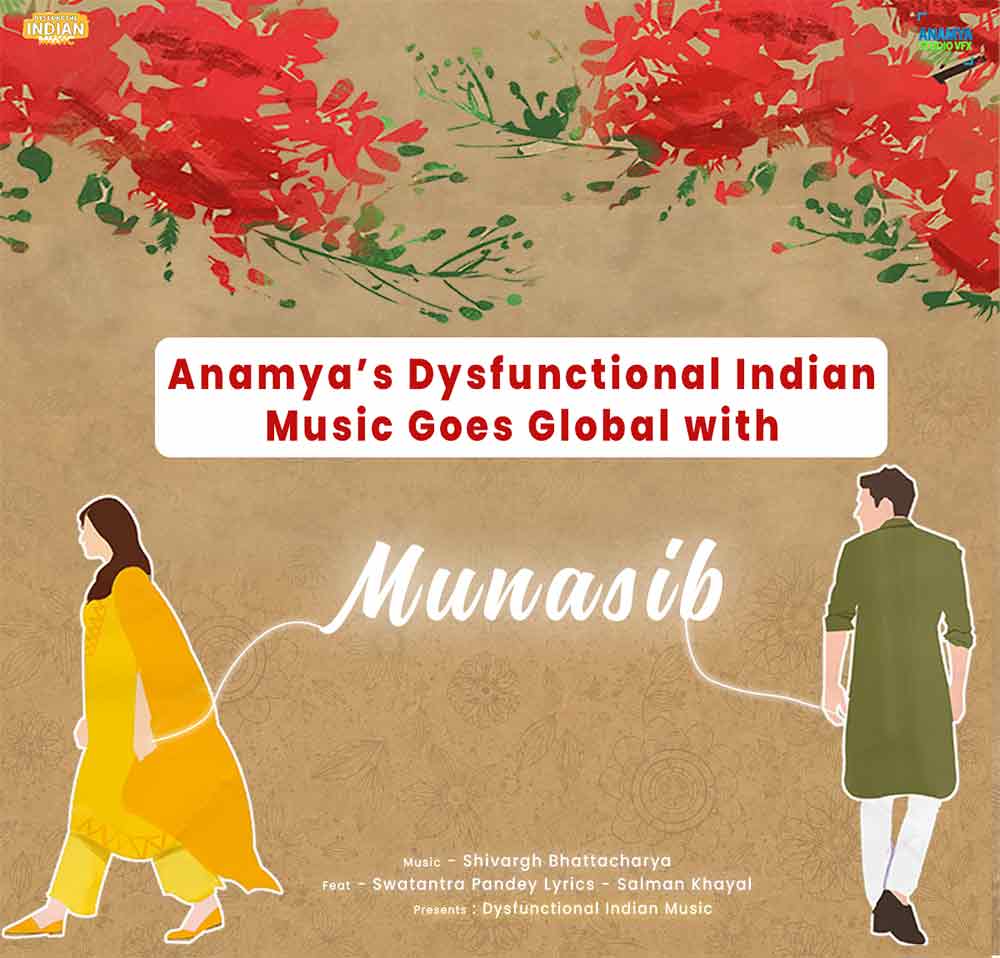
For Anamya, “Munasib” is not just another release. It is a special song because of the emotion behind it, the artists who shaped it, and the cross-border appreciation it has received. The song brings together independent Indian music, soulful South Asian instrumentation, and a sincere creative vision that allows it to travel beyond one market or one audience.
From featuring Sapna Udara Rajapaksha, an extraordinary Esraj player from Sri Lanka, to receiving appreciation from Pakistan Coke Studio fame Zeeshan Ali, “Munasib” has become a meaningful example of Indian indie music gaining international audience.
It is not a song trying to chase noise. It is a song that quietly asks the listener to pause, feel, and make space for it.
The first thing that stands out about “Munasib” is its honesty.
In a time when many songs are built only for short attention spans, quick reels, and instant hooks, “Munasib” takes a softer route. It does not rush the listener. It allows the emotion to breathe.
That is what makes it connect.
The word “Munasib” itself carries a feeling of rightness — something that feels suitable, destined, or emotionally correct for a particular moment. The song carries that same mood. It feels like a memory, a confession, or a feeling that was never loudly spoken but deeply understood.
This is why listeners searching for best Indian indie songs, emotional Indian songs, or unique Indian music can find something genuine in “Munasib.” It does not sound manufactured. It sounds lived.
One of the most special parts of “Munasib” is the contribution of Sapna Udara Rajapaksha, an Esraj player from Sri Lanka.
The Esraj is not just another instrument in the arrangement. It has a deeply emotional, almost voice-like quality. When used beautifully, it can make a song feel cinematic, spiritual, and intimate at the same time.
In “Munasib,” Sapna Udara’s Esraj part adds a unique dimension to the track. His playing gives the song a South Asian soul — something rooted, delicate, and emotionally rich. It does not overpower the song. It quietly lifts it.
This collaboration also makes “Munasib” stand out as more than a regular new Indian music release. It carries the sound of a Sri Lankan musician, the emotional world of Indian independent music, and appreciation from across borders.
That is how Indian music reaching global audience often begins — not only through big campaigns, but through real collaborations, genuine artistry, and emotional connection.
At the centre of “Munasib” are the artists and collaborators who shaped its emotional identity, including Shivargh Bhattacharya and Swatantra Pandey.
The song has a sincerity that feels rare. It does not try to copy a mainstream sound. It does not feel like it was created only to fit a trend. Instead, it has its own emotional world — gentle, poetic, and thoughtful.
The vocals, composition, arrangement, and overall mood come together to create something personal. This is where an strong Anamya Munasib review must go beyond simply asking whether the song is catchy. The real strength of “Munasib” is that it stays with the listener.
That is what makes it stand out in the growing space of alternative Indian music artist releases and independent music coming from India.
Another special moment in the journey of “Munasib” came when Zeeshan Ali, known for his association with Pakistan Coke Studio fame, gave a heartfelt shoutout to the song.
For any independent release, this kind of appreciation matters. It shows that the track is not only being promoted, but also being heard and felt by artists outside its immediate circle.
Music from India, Pakistan, Sri Lanka, and the larger South Asian region has always shared a deep emotional connection. Melody, poetry, longing, heartbreak, and soul travel easily across borders. A song like “Munasib” fits beautifully into that shared emotional space.
The shoutout from Zeeshan Ali becomes more than just a social media moment. It becomes a sign that “Munasib” is touching listeners and artists beyond boundaries.
For Dysfunctional Indian Music, that is a meaningful step.
Many people may search for why Munasib by Anamya is trending, but the song’s strength is not built on loud virality. It is built on slow, genuine connection.
“Munasib” is being noticed because it has qualities that today’s independent music audience is actively looking for. It feels honest. It has a distinct sound. It brings together artists from different creative backgrounds. It features a rare and beautiful instrument like the Esraj. It has received cross-border appreciation. Most importantly, it does not feel forced.
This matters because the future of Indian indie music trends is not only about fast numbers. It is also about emotional recall. A song becomes important when listeners remember how it made them feel.
“Munasib” has that quality.
It is not just another song in the feed. It is a track that reflects where Indian independent music can go when it is treated with patience, taste, and sincerity.
Dysfunctional Indian Music is being developed as more than just a page for releasing songs. It is the music wing of Anamya Productions & Consultancy Private Limited, created with the idea of giving artists a platform where music, storytelling, visuals, and identity can come together.
This is important because music today is not experienced only as audio. A song is heard, watched, shared, posted, clipped, captioned, and remembered visually. An artist today needs more than a release. They need presentation, positioning, and a creative ecosystem.
That is where Anamya’s background in storytelling and production becomes important.
As a company, Anamya Productions & Consultancy Private Limited has been building work across films, campaigns, music, social impact content, kids’ content, visual storytelling, and creative development. With Dysfunctional Indian Music, the company is using that larger creative experience to build a music platform where artists can be introduced with stronger identity and better storytelling.
For anyone searching for best dysfunctional Indian music artist, Indian independent music artist, or unique Indian music, Dysfunctional Indian Music is slowly becoming a name to watch.
The journey of “Munasib” is only one part of the larger vision.
Anamya is now expanding the horizon of Dysfunctional Indian Music for 2026 with more songs, more music videos, and more collaborations with fresh independent voices. The aim is to build a stronger catalogue and create a space where new-age artists can grow with better creative support, stronger presentation, and a clear musical identity.
This is exactly the kind of space Dysfunctional Indian Music wants to build.
In 2026, this expansion can become a strong step for Anamya’s music wing as it moves from individual releases to a more recognisable independent music platform.
The way people discover music has completely changed.
Earlier, Indian music mostly reached international audiences through Bollywood, classical music, or diaspora communities. Today, a listener can discover a song through an Instagram story, a reel, a playlist, an artist page, a shoutout, or a collaboration from another country.
That is why Indian indie music gaining international audience is no longer a distant idea. It is already happening, slowly and organically.
A listener does not always need to understand every word of a song to feel its mood. Emotion travels faster than language. A melody, an instrument, a voice, or a visual moment can connect with people anywhere.
“Munasib” has that kind of emotional quality.
It may be rooted in Indian independent music, but its feeling is universal. Love, longing, memory, timing, silence, and hope are not limited to one country. The song carries these emotions with sincerity, which is why it has the potential to reach listeners beyond India.
What makes “Munasib” interesting is not only the song, but the story around it.
All these elements create a complete narrative.
This is where Anamya’s storytelling strength becomes important. The company understands that a song should not just be uploaded and forgotten. It should be presented with a sense of mood, memory, and identity.
In the case of “Munasib,” the song feels like part of a larger emotional world. The artwork, the artist highlights, the musician stories, and the cross-border appreciation all add to the song’s personality.
That is the difference between simply releasing music and building a music wing.
For Anamya Productions & Consultancy Private Limited, Dysfunctional Indian Music is not just another creative experiment. It is a serious music wing with the potential to grow into a strong platform for independent artists.
“Munasib” shows what this platform can represent.
This is why “Munasib” becomes important in the journey of Dysfunctional Indian Music. It is not only a song; it is a statement of intent.
It shows that Anamya is interested in music that has feeling, identity, and long-term value.
“The Music Wing to Watch” is not just a headline. It is a direction.
With “Munasib,” Dysfunctional Indian Music has shown that independent music can be soft and powerful at the same time. It can be rooted in India and still travel beyond India. It can feature a Sri Lankan Esraj player, receive appreciation from Pakistan, and still remain deeply connected to its own emotional identity.
That is the beauty of music when it is made with honesty.
As Anamya expands Dysfunctional Indian Music in 2026 with more songs, more music videos, and more new-age independent artists, the platform has the potential to become a meaningful space in the Indian indie music scene.
For listeners searching for best Indian indie songs, Indian independent music artist, alternative Indian music artist, new Indian music release, or simply music that feels real, “Munasib” is a song worth discovering.
It does not demand attention loudly.
It simply makes space for emotion.
And maybe that is exactly why it feels so right.
Maybe that is why it feels truly Munasib.