Released in 2021, Money Tree transforms a young woman’s startup ambition into an intimate family story about money, honesty, patience and the real meaning of sustainable growth.
A young woman approaches her elder brother with an ambitious plan: she wants to launch a startup.
She is influenced by a business culture in which young companies appear to raise enormous amounts of capital almost overnight. Startups expand rapidly, valuations rise, and founders emerge as visible symbols of modern success. To her, the sector represents opportunity, innovation and a faster path towards financial growth.
Her brother does not reject her ambition. He does not tell her that startups are wrong or that she should stop dreaming.
Instead, he makes her think.
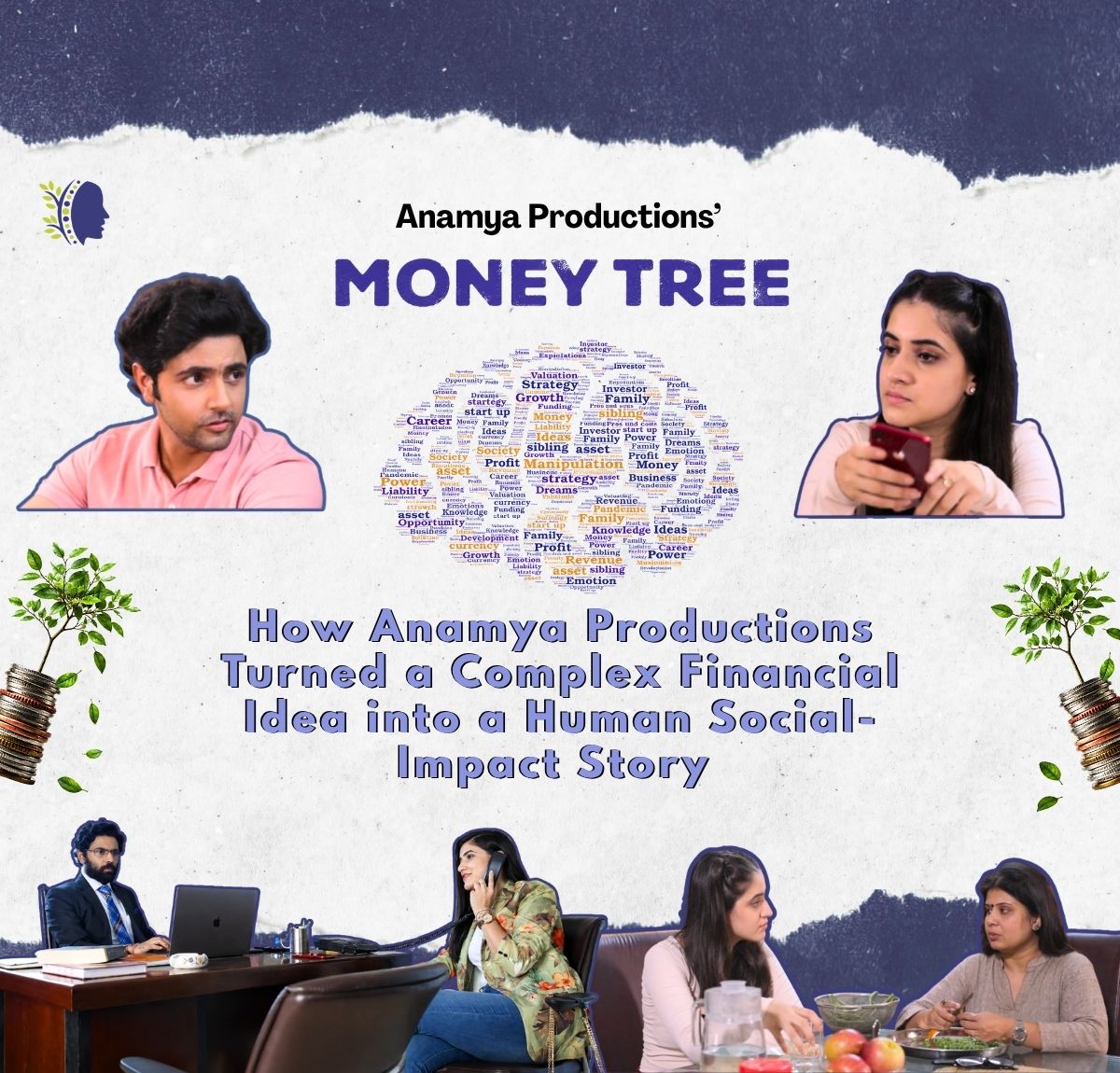
Does she not find it unusual that so much money can suddenly flow into the startup ecosystem—sometimes before a company has established a stable business or demonstrated that it can sustain itself?
Where is all this money coming from? What gives it value? And should the presence of large investments automatically be mistaken for the creation of genuine wealth?
That question becomes the narrative starting point of Money Tree, a social-impact short film presented by Anamya Productions. The film premiered on YouTube on 3 September 2021 and continues to feature within Anamya Productions’ publicly showcased body of social-impact work. (YouTube)
Watch the complete film: Money Tree by Anamya Productions on YouTube
Subjects such as money, startup funding, inflation and financial systems are not naturally cinematic.
They do not arrive with obvious action, visual spectacle or emotional conflict. Presented too directly, they can turn a film into a lecture. Simplified carelessly, they can lose their meaning. Explained excessively, they can overwhelm the audience and weaken the human connection.
Translating such a subject into an accessible story is therefore a demanding screenwriting and communication exercise.
The writer must understand the subject deeply, but the final screenplay cannot feel like a display of research. Information has to become dialogue. Ideas have to emerge from character. The audience must understand the concept without feeling that the film has paused to teach it.
Money Tree approaches this challenge through a familiar and emotionally accessible relationship: a younger sister seeking guidance from her elder brother.
She does not enter the story looking for an explanation of monetary systems. She wants to make a decision about her future. Her desire to start a startup gives the conversation its dramatic purpose.
The brother does not respond as an economist, banker or financial adviser. He responds as a sibling who wants her to question a trend before committing herself to it.
This is where the film’s storytelling becomes important. The subject is complex, but the situation is simple. The conversation is intellectual, but its motivation is emotional.
The sister sees the startup ecosystem through its most attractive possibilities: rapid growth, abundant investment and the opportunity to build something significant within a relatively short period.
The brother asks her to look beneath that visible excitement. His concern is not that investment is inherently wrong or that every startup lacks substance. His concern is the speed and volume with which money can enter the sector—and how easily that flow of capital can be confused with genuine business success.
He encourages her not to follow the startup trend merely because it appears fashionable or financially rewarding. Instead, he asks her to consider a more traditional, fundamentals-led approach: work honestly, build patiently and create something capable of growing through the value it provides.
Within the film, “traditional” does not mean outdated.
It means rooted.
The brother is not asking his sister to become less ambitious. He is asking her not to rush blindly into an ecosystem she has not yet fully understood.
From the startup question, the conversation moves organically into the history and changing nature of money. The brother explains that paper currency once operated within monetary systems formally linked to gold. The paper note did not itself possess gold’s intrinsic material value; its credibility came from a recognised convertibility arrangement. Under the post-war Bretton Woods system, participating currencies were generally linked to the US dollar, while official foreign dollar holdings were convertible into gold at $35 an ounce. When the United States ended that convertibility in 1971, the dollar did not suddenly become powerful or valueless—it was already central to international finance. What changed was that it continued as a fiat currency, supported by state authority, economic strength, institutions and confidence rather than a fixed gold-redemption commitment. Money Tree uses this transition to question how money can be managed, expanded, controlled and potentially manipulated once its value is no longer tied to a fixed quantity of gold. (Federal Reserve History)
The film then connects this larger idea with ordinary life. Within the narrative, the brother refers to an approximate ?13-lakh-crore figure and uses the tentative family example of a house purchased for around ?30 lakh that later came to be valued at approximately ?4 crore. These are illustrative references from the film, not audited economic data or independently assessed property valuations. Through the family house, the share market and the increasing cost of everyday commodities, the film raises a striking contradiction: when the value of an asset we own rises, we celebrate; when food, fuel and daily necessities become more expensive, we demand answers. The film suggests that these experiences are not entirely disconnected—the movement of money, credit, investment and prices can be part of the same wider financial environment.
According to production information provided by Anamya Productions, the research and scripting of Money Tree took approximately one year.
The research and screenplay development were led by Apoorv Chaturvedi, who subsequently played the elder brother in the film.
The significance of that development period lies not merely in the amount of information studied, but in the difficulty of transforming that information into a story.
Research and screenplay writing serve very different purposes.
Research attempts to understand and preserve information. A screenplay must select only what the audience needs, introduce it at the correct moment and ensure that it remains connected to the characters’ emotional journey.
The financial concepts could not simply be placed inside the brother’s dialogue. They needed to emerge naturally from the sister’s startup plan.
Her ambition creates the question.
His concern creates the reason to investigate it.
Their relationship allows the conversation to grow without introducing an external expert or formal narrator.
This required the research to become almost invisible in the finished film. The audience had to experience a brother guiding his sister—not an actor reciting an economic note.
That ability to conceal complexity beneath an apparently simple conversation is central to the film’s communication approach.
The family setting is not decorative.
It is the structure through which the film makes a complicated subject understandable.
The younger sister represents ambition, curiosity and the attraction of fast-moving trends. The elder brother represents reflection, patience and the willingness to question what appears normal. The mother’s presence gives the exchange a wider emotional context and keeps the conversation grounded within an ordinary household.
Financial decisions rarely affect only one person.
The decision to start a business can influence family security. The pressure to succeed quickly can alter relationships and priorities. The consequences of financial choices are ultimately experienced not only in markets or companies, but inside homes.
By locating the conversation within a family, Money Tree gives its subject warmth and familiarity.
The brother’s questions do not emerge from cynicism. He is not trying to defeat his sister’s argument or demonstrate that he knows more than she does. He wants her to slow down before making an important decision.
His guidance is an act of concern.
The sister, similarly, is not portrayed as foolish. Her attraction to the startup world is understandable. She belongs to a generation constantly exposed to funding announcements, rising valuations and stories of people achieving extraordinary success at a young age.
The film respects her ambition while asking her to examine it.
A conventional awareness film may begin with a fact, a statistic or a voice-over explaining what the audience should understand.
Money Tree begins with a character who wants something.
The sister’s startup ambition creates the scene. The brother’s question introduces the conflict. That conflict opens a larger discussion. The family gives the discussion emotional meaning.
This is the difference between presenting information and building communication through cinema.
An explainer can define a concept.
A story makes that concept matter to someone.
The family-house example works because it is not introduced merely as a financial asset. It belongs to the characters’ shared history. Its tentative change in value becomes understandable because the audience can relate it to a real family experience.
The startup idea works for the same reason. The sister is not discussing the sector academically; she is considering entering it. The information may influence a decision that matters to her future.
The message is therefore embedded within the drama rather than added separately to it.
“Slow and Steady Wins the Race”
Beneath its discussion of startups and money, Money Tree carries a simple and timeless lesson:
The film does not present patience as a lack of ambition. It presents patience as a form of maturity.
The brother encourages his sister not to rush into a field merely because it is fashionable or because others appear to be succeeding quickly. Whatever she chooses to do should be approached with honesty, understanding and commitment.
She should not allow a trend to make the decision for her.
She should not confuse the availability of money with the existence of real value.
She should understand what she is building and give it the time required to develop strong foundations.
In this sense, Money Tree is not an anti-startup film.
It is a film against unexamined ambition and trend-driven haste.
Its message extends far beyond business:
Do not rush simply because the world is moving quickly.
Do not imitate an outcome without understanding the process behind it.
Do not sacrifice honesty for visibility.
And do not assume that rapid growth is automatically sustainable growth.
The film’s on-screen credits identify:
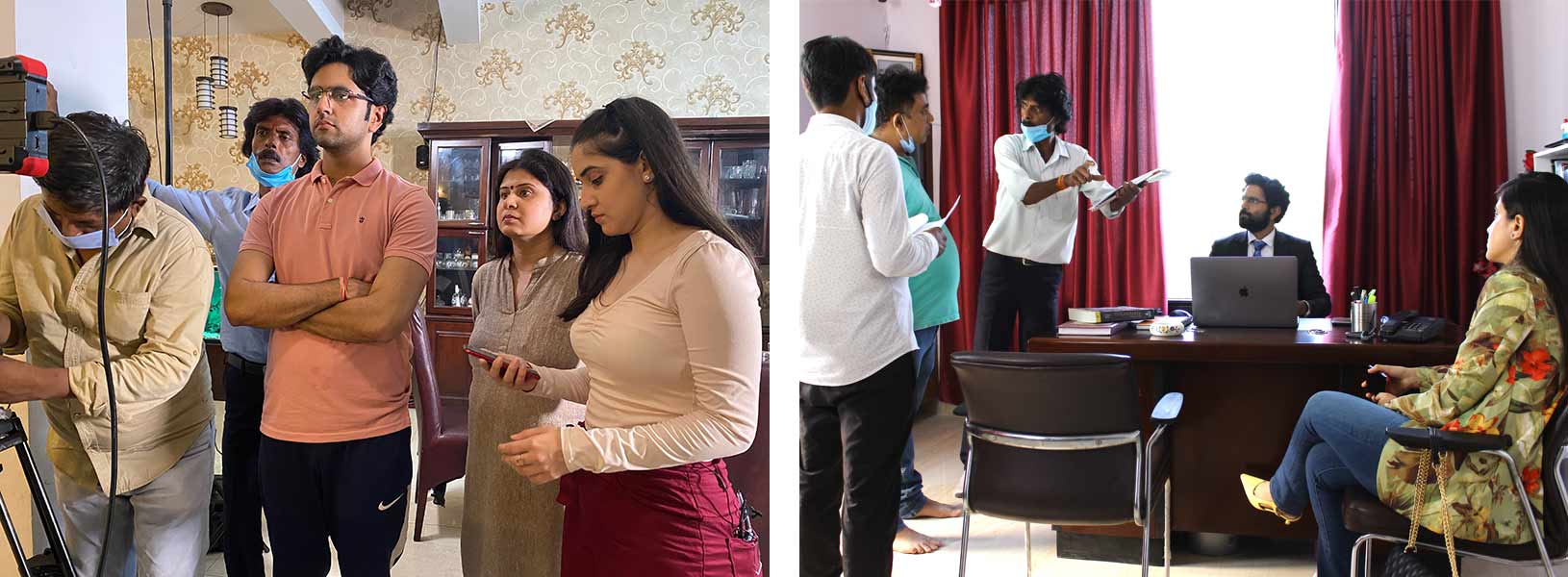
Apoorv Chaturvedi — Brother
Vaasavi Shasan — Sister
Tulika Banerjee — Mother
Apoorv Chaturvedi as the Brother
Apoorv Chaturvedi carries the central narrative and intellectual responsibility of the film.
His involvement extended from research and screenplay development to performance. This required the character’s knowledge to remain emotionally believable. The brother could not appear to be delivering a prepared lecture; he needed to remain a concerned sibling throughout the conversation.
His function in the story is not to hand his sister a formula for success. It is to make her question an assumption she had accepted without examining.
The younger sister is played by Vaasavi Shasan, who publicly uses the name Vaasavi Shashan.
An actor and digital content creator, she has built a substantial social-media presence, making her particularly relevant to a character shaped by contemporary digital culture and rapidly changing ideas of success. (Qoruz)
Her character gives the audience an accessible entry point into the film. She is ambitious, curious and attracted to a trend that promises speed. The film’s purpose is not to ridicule that attraction, but to deepen her understanding.
Tulika Banerjee plays the mother, giving the story maturity and emotional grounding.
Banerjee is known for portraying the wife of Bobby Deol’s character in Aashram and a judge in Madam Chief Minister. Her wider work includes films, web series, short films and television commercials. (Hindustan Times)
Her presence helps preserve the film’s identity as a family story even when its ideas become wider and more conceptual.
The film’s on-screen credits also identify:
Executive Producer — Haider Zaidi
Director of Photography — Indrajeet Kumar
Film Editor — Ashwani Singh
These clearly defined responsibilities reflect the professional, department-led approach applied to the production.
A dialogue-driven short film can appear deceptively simple. Without constant action or frequent location changes, the film depends heavily on performance, framing, visual continuity, reaction and editorial rhythm.
The cinematography must maintain visual interest without distracting from the conversation.
The performances must make researched material feel natural.
The edit must manage the density of information while preserving pauses, reactions and emotional progression.
The production must ensure that the film remains a story rather than becoming an illustrated research paper.
This is where Money Tree reflects Anamya Productions’ approach to social-impact filmmaking in 2021. The complexity of the subject was not treated as a reason to rely only on explanation. Research, screenplay, performance, cinematography and post-production were brought together to serve one accessible narrative.
Anamya Productions continues to position social impact and purpose-driven storytelling as central to its work, with Money Tree included in its public portfolio. (Anamya Productions)
Money Tree was edited by Ashwani Singh.
The editorial responsibility was particularly important because the film moves from a casual startup conversation into a larger conceptual space before returning to its human message of patience and honest growth.
Those movements needed to feel like one continuous conversation.
The editor had to create room for the audience to absorb the ideas while ensuring that the film did not lose its emotional rhythm.
Ashwani Singh later worked on the Akshay Kumar-starrer OMG 2 as Associate Editor and Post-Production Creative. (IMDb)
The relevance of this credit is not a comparison between the scale of the two films. It reflects the specialist editorial involvement brought to Money Tree and the seriousness with which its post-production was approached.
Released in 2021, Money Tree represents an early expression of Anamya Productions’ approach to impact-oriented filmmaking.
The film does not merely discuss a social concern. It demonstrates how a difficult subject can be converted into an accessible screen narrative.
A complex idea is introduced through a relatable ambition.
Research is transformed into dialogue.
Information is softened through family interaction.
The message emerges gradually rather than being announced.
This is what gives the film its production-house identity.
Money Tree is not positioned as a definitive economic study. It is a social-impact story designed to make an audience pause, question and reconsider the meaning of quick success.
Its communication achievement lies in making a dense subject feel personal.
The sister begins the film wanting to start a startup.
Her brother does not end that dream.
He changes the way she looks at it.
He makes her question how so much money can enter a sector so quickly, what gives that money value and whether financial abundance should automatically be confused with genuine progress.
But the film’s final message is larger than finance.
Whatever you choose to build, build it honestly.
Do not rush into a trend because everyone else appears to be following it.
Understand the foundations before attempting to grow.
Give meaningful work the time required to develop.
And remember that success created patiently and responsibly is more likely to survive than success built only around speed.
That is why the title Money Tree feels appropriate.
A tree cannot become strong through rapid expansion alone. It requires roots, nourishment, time and balance.
So does a business.
So does success.
And so does a life.
Developed through approximately a year of research and screenplay work, carried by an experienced cast and executed through clearly defined production and post-production roles, Money Tree reflects Anamya Productions’ commitment to converting complex social subjects into accessible human stories.
Its message remains direct:
Dream boldly, but do not rush blindly. Work honestly, grow steadily and build from the roots.
Watch Money Tree
Money Tree — Official Film by Anamya Productions
The references to approximately ?13 lakh crore, a family house purchased for around ?30 lakh, and its later value of approximately ?4 crore are tentative, illustrative figures used within the film’s narrative. They should not be interpreted as audited financial data, an independently assessed property valuation or investment advice.