Strong children’s content is not defined by entertainment alone. It is shaped by the ideas it introduces, the questions it encourages and the characters through whom young audiences begin to understand the world around them.
This creative philosophy forms the foundation of Rango Tango – Vigyaan Ki Masti, an original 3D animated edutainment series produced by Anamya Productions & Consultancy Private Limited.
Created as India’s first 3D animated edutainment series in a vertical format, the show combines science-led storytelling, humour, friendship and problem-solving within a visual language developed for contemporary digital audiences.
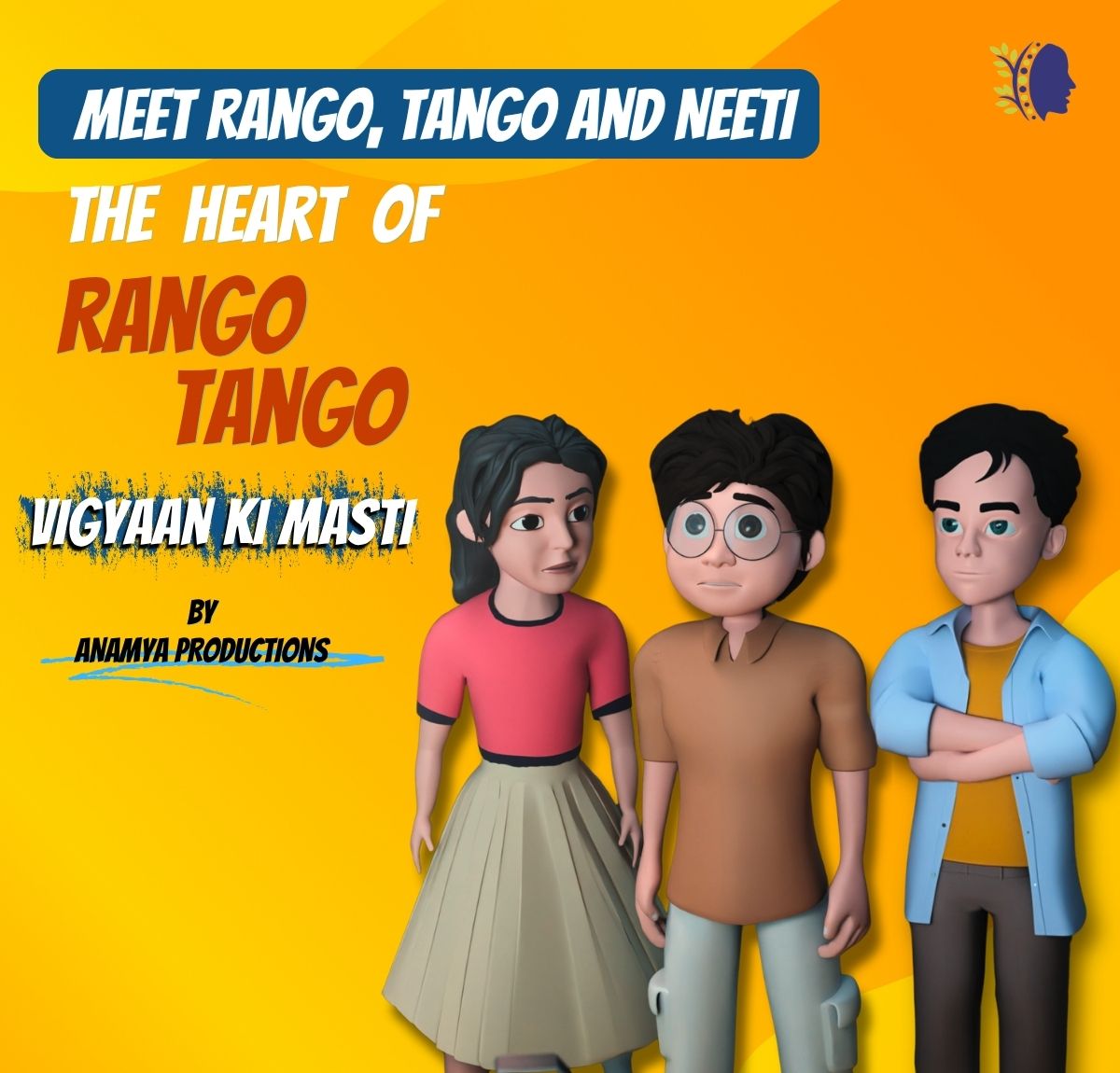
At the centre of the series are Rango, Tango and Neeti—three young characters whose personalities, abilities and individual ways of thinking shape the larger world of Vigyaan Nagri.
Rango is a gifted young science enthusiast who conducts experiments and uses scientific knowledge to find practical solutions.
Neeti brings logic, calculation and analytical clarity to the process.
Tango contributes instinct, energy and the confidence required to turn ideas into action.
Together, they form a complementary team in which imagination, reasoning and practical execution work towards a common purpose.
The strength of the Rango Tango Vigyaan Ki Masti characters lies not merely in their individual qualities, but in the way those qualities come together. Their friendship gives the series warmth, while their collaborative approach gives it educational depth.
The central idea behind the Rango Tango Educational Series is that science becomes more meaningful when children encounter it through situations, consequences and stories rather than isolated facts.
Each episode begins with a problem, mystery or unusual development within Vigyaan Nagri. The situation may arise from an experiment, an environmental concern, an everyday misunderstanding or an unexpected event affecting the community.
Instead of receiving an immediate explanation, the characters must first understand what has happened.
They observe the situation, gather information, discuss possible causes and test different ideas. Scientific thinking is therefore not added to the story as a separate lesson. It becomes part of the narrative itself.
This allows the series to present science as a method of approaching the world.
It encourages children to understand that solutions are rarely discovered through guesswork alone. They emerge through curiosity, observation, experimentation, reasoning and collaboration.
For young viewers, this approach makes scientific ideas more accessible. For parents and educators, it creates opportunities to introduce logical thinking and problem-solving without making the experience feel overly academic.
The series treats curiosity not as a distraction from learning, but as the beginning of it.
Rango is the central scientific force within the trio.
He is remarkably talented, deeply curious and naturally drawn towards experiments. When a problem appears in Vigyaan Nagri, his first instinct is to understand why it has occurred and how scientific knowledge can be used to solve it.
Rango does not simply imagine inventions. He conducts experiments, studies their outcomes and applies what he learns to real situations.
This gives his character both creativity and purpose.
His experiments often form the starting point of the group’s investigations. He studies materials, observes reactions, examines patterns and develops possible solutions. Yet the process is rarely straightforward. An experiment may produce an unexpected result, an early theory may prove incomplete or an invention may require further improvement.
These moments are essential to Rango’s character.
They show young viewers that scientific ability is not defined by always being correct. It is defined by the willingness to investigate, revise and continue working until a reliable solution is found.
Rango therefore represents talent supported by discipline.
He is gifted, but his success does not come from talent alone. It comes from observation, patience, experimentation and the confidence to learn from an imperfect result.
What distinguishes Rango is his ability to connect scientific understanding with practical problem-solving.
His experiments are not performed merely to demonstrate knowledge. They are undertaken with a clear objective: to understand a challenge and improve the situation.
This makes his scientific curiosity socially relevant within the world of Vigyaan Nagri.
Whether he is examining an unusual phenomenon, developing an invention or attempting to correct an unintended consequence, Rango approaches science as a tool for finding answers.
His process broadly reflects the foundations of scientific inquiry:
He then refines the solution with the support of Neeti and Tango.
This process unfolds through storytelling rather than formal instruction, allowing young viewers to absorb the logic of experimentation naturally.
Although Rango often leads the scientific process, he is not presented as an all-knowing hero who solves every challenge independently.
His strength is amplified by the abilities of his friends.
Neeti helps him analyse information, verify calculations and recognise details that may have been overlooked. Tango supports the practical execution of the plan, responds quickly to changing situations and often contributes observations grounded in physical experience.
The final solution therefore emerges through their combined strengths.
Rango brings scientific ability and experimentation.
Neeti brings logic and precision.
Tango brings instinct and action.
This collaborative dynamic gives Rango greater credibility. He is a gifted young problem-solver, but he also understands that meaningful solutions are often developed through teamwork.
His leadership is not based on dominating the group. It is based on initiating the scientific process and allowing the abilities of his friends to strengthen the outcome.
Neeti provides analytical depth to the group.
She is intelligent, observant and methodical. When a situation becomes confusing, she looks for patterns. When an explanation appears incomplete, she studies the available evidence before accepting it.
Her contribution is essential because scientific creativity requires analytical discipline.
Rango may develop an experiment or propose a new solution, but Neeti helps determine whether the reasoning behind it is sound. She examines the details, verifies calculations and raises questions that enable the group to approach the problem more accurately.
Her role is not to restrict Rango’s imagination. It is to give it structure.
Neeti encourages the trio to distinguish between what appears to be true and what can actually be verified.
She asks whether the available evidence supports the conclusion, whether another explanation is possible and whether the result of an experiment is consistent.
These are fundamental scientific habits, but they are equally important in everyday decision-making.
Through Neeti, children are introduced to the value of precision, patience and intellectual honesty.
Neeti also contributes to the representation of young girls as active participants in science, reasoning and problem-solving.
She is not positioned as a secondary observer within the group. Her contribution frequently determines whether an investigation moves in the correct direction.
Her intelligence is expressed through concentration, logical thinking and an ability to recognise relationships between apparently separate details.
This representation matters because children form ideas about capability through the characters they repeatedly encounter.
Through Neeti, young girls can see a character who is confident in her intelligence, actively involved in scientific investigation and central to the resolution of the story.
At the same time, her character communicates a wider message to all viewers: careful reasoning is not the opposite of adventure. It is often what makes a successful outcome possible.
Tango brings movement, spontaneity and practical confidence to the trio.
He is energetic, responsive and closely connected to physical experience. His love for football influences the way he understands timing, direction, coordination and space.
Where Rango may begin with an experiment and Neeti with analysis, Tango often begins with action.
His instinctive nature gives momentum to the narrative. It also creates a useful balance within the group, particularly when a scientific plan must be translated into practical execution.
Tango is often the first to step forward when an idea needs to be tested or when the group must respond quickly to a new development.
His humour emerges naturally from his personality. He reacts directly, speaks honestly and occasionally moves faster than the plan requires. Yet he is more than a source of comic relief.
He contributes courage, loyalty and practical awareness.
In many situations, Tango’s understanding of movement and his ability to react quickly become as important as Rango’s scientific knowledge or Neeti’s analysis.
Through Tango, the series can introduce scientific ideas connected with sports and physical activity.
Force, balance, speed, direction, momentum, angles and coordination become easier to understand when they are linked to experiences already familiar to children.
A moving football can demonstrate force and momentum.
A goal attempt can introduce direction and angles.
A sudden change in speed can help explain motion.
A team game can reflect the importance of coordination and planning.
Through this approach, the Science Learning Cartoon for Kids makes scientific concepts visible within everyday activity.
Tango also represents practical intelligence—the ability to understand a situation through physical awareness, instinct and direct participation.
His character reminds viewers that intelligence is not expressed only through experiments or calculations. It can also appear through timing, observation, movement and the confidence to act at the right moment.
The relationship between Rango, Tango and Neeti forms the intellectual and emotional foundation of the series.
Rango leads the scientific investigation.
Neeti examines the logic and evidence.
Tango helps translate the solution into action.
The trio works because no single character is complete in every situation.
Rango may conduct an experiment and develop the most promising solution, but Neeti may identify an important calculation or inconsistency. Tango may then help test the idea under real conditions.
At another moment, Tango’s physical observation may reveal a clue that Rango and Neeti had not initially considered. Neeti may interpret its significance, allowing Rango to design a more accurate experiment.
This dynamic presents a mature understanding of teamwork.
The characters do not become effective by thinking in the same way. They become effective by recognising the value of their differences.
Creative scientific ability, logical reasoning and practical intelligence are treated as equally important parts of the problem-solving process.
This allows different kinds of young viewers to identify with the series.
A child who enjoys experiments and inventions may connect with Rango.
A child who prefers calculations, patterns and careful observation may relate to Neeti.
A child who learns through movement and practical experience may see themselves in Tango.
Together, the trio creates a broader and more inclusive representation of intelligence.
One of the defining qualities of the Vigyaan Ki Masti Kids Show is the way it approaches science.
Science is not presented only through laboratories, equipment or technical terminology. It is presented as a disciplined way of responding to uncertainty.
When something unusual happens, the characters investigate rather than assume.
When an experiment fails, they reconsider the method.
When different explanations are possible, they compare them.
When they reach a conclusion, it must correspond with the evidence available.
This structure introduces young viewers to the scientific method without turning every episode into a formal lesson.
The process becomes intuitive because it is connected to a visible problem and a character-led story.
Children see that understanding often requires patience. They also see that the first explanation may not always be the correct one.
In this way, the series encourages habits that extend beyond the study of science, including critical thinking, intellectual flexibility and the ability to reconsider an earlier assumption.
Although the series is led by science, its educational value is not limited to scientific information.
Each adventure also examines responsibility, communication and the consequences of individual choices.
An experiment may create an unintended result.
A misunderstanding may lead the community towards an incorrect conclusion.
A character may need to acknowledge a mistake and take responsibility for correcting it.
In such situations, the trio must do more than discover a technical answer. They must communicate, cooperate and consider how their actions affect others.
The series therefore connects knowledge with responsibility.
Scientific ability becomes meaningful when it is used constructively.
Curiosity becomes valuable when it is supported by patience and care.
Confidence becomes stronger when it remains open to correction.
These themes give Rango Tango – Vigyaan Ki Masti a wider educational purpose. The series is interested not only in what children know, but also in how they think, collaborate and apply that knowledge.
The format of the series is central to its identity.
Produced by Anamya Productions & Consultancy Private Limited, Rango Tango – Vigyaan Ki Masti is India’s first 3D animated series created in a vertical format with an integrated edutainment element.
The series has been conceived for a generation that increasingly discovers and consumes content on mobile screens.
Rather than producing a conventional horizontal show and later adapting it for vertical viewing, the visual storytelling of Rango Tango – Vigyaan Ki Masti is developed for the vertical frame from the beginning.
Character placement, visual depth, movement and narrative focus are composed around the mobile viewing experience.
This vertical-native approach gives the series a distinctive identity within the landscape of
Educational Science Animation in India.
It also demonstrates how children’s content can evolve alongside changing formats without compromising storytelling, character development or educational purpose.
Vigyaan Nagri provides the series with a recognisable and expandable narrative world.
It is a community where everyday situations can become scientific investigations and where unusual challenges create opportunities for discovery.
Science is not separated from life in Vigyaan Nagri. It is present within its environment, relationships and problems.
This gives the series an Indian foundation while allowing its central themes to remain universal.
Curiosity, friendship, responsibility and the desire to find a solution are relevant to children across cultures.
Through Anamya Productions’ Rango Tango, these ideas are expressed through an original animated universe created for a new generation of digital viewers.
The intention is not merely to place Indian characters inside an existing format. It is to develop a distinct storytelling identity that combines Indian imagination, contemporary 3D animation and a meaningful edutainment purpose.
Parents and educators increasingly look for children’s content that can entertain without encouraging passive viewing.
They want stories that remain engaging while also developing curiosity, reasoning and the confidence to ask questions.
Rango Tango – Vigyaan Ki Masti is designed around this balance.
Each episode can become the beginning of a larger conversation.
Parents and educators can ask children what caused the central problem, why Rango selected a particular experiment, how Neeti helped analyse the situation and what Tango contributed to the final solution.
They can also discuss why the first attempt may not have worked and whether another method could have produced a different result.
The purpose is not to test memory. It is to extend the habit of inquiry.
A meaningful educational series should continue working after the screen is switched off. It should leave behind a question, an observation or a new way of interpreting an everyday experience.
Rango, Tango and Neeti are central to the series because they represent a complete problem-solving process.
Rango brings scientific talent, experimentation and the ability to develop practical solutions.
Neeti brings logic, evidence and analytical clarity.
Tango brings energy, instinct and the confidence to put an idea into action.
Their friendship gives the series warmth, but their collaborative intelligence gives it purpose.
Rango may lead the scientific investigation, yet the most effective solutions emerge when his talent is supported by Neeti’s reasoning and Tango’s practical contribution.
Together, they demonstrate that meaningful discovery rarely depends on one ability alone. It develops through experimentation, analysis, action and teamwork.
That is what makes Rango, Tango and Neeti the heart of Rango Tango – Vigyaan Ki Masti.
Produced by Anamya Productions & Consultancy Private Limited, the series brings together vertical-native 3D animation, science-led storytelling and an original Indian edutainment vision.
In Vigyaan Nagri, every challenge creates a question, every question begins an experiment, and every experiment brings Rango, Tango and Neeti closer to a thoughtful and practical solution.